Chapter 8. The Roaring Twenties
It took some time for the junior game to resume after the War. The professionals had restarted in January 1919, but for local clubs it took much longer to reorganise, muster players and find grounds. Encouraged by Halifax NUFC with financial support, the junior league committee met on 13 March 1919 at their usual Upper George venue, lamenting that football had practically been at a standstill for four years. The meeting was told that junior football had restarted in Hull and York though not elsewhere.
With the season nearing its end, a knock-out competition was the obvious way to go. Mill Bank reported that only two players had been demobilised so far and nine of their former players had been killed, but Wyke said they now had about eleven players back and the Pineberry, Elland Wanderers and Hebden Bridge reps all guaranteed teams. Hiring a ground for possibly just one cup game was an expensive problem, but Thrum Hall was made available and Elland offered their ground at Old Earth. There would be no age limits. The local newspaper got behind the plan, offering another Courier Cup for the winners. Their earlier trophy with that name was changed into a Courier Boys Cup, won in 1921 by Smith Bulmer’s over Siddal. The Courier Bowl became an Under 16 cup, contested by teams including Claremount, Elland Lane, Halifax Boys Club, North Dean and Halifax Supporters; a new Thrum Hall Juniors team were to win it in their first season in 1923-4 and again the following year. Later the Courier Bowl was transferred to the schools competition.
The new Thrum Hall Juniors were mostly former soccer players, mustered together by W.Holgate alongside W.H.Garside, a former Halifax player from the 1890s, whose son Reggie was captain. Eric Lingard, who in his adult life was to become a prominent amateur league official and then Halifax RLFC chairman, played on the wing and also acted as secretary.
Nine clubs entered the new Courier Cup, necessitating a preliminary round between Wyke and Elland at Thrum Hall. The other seven were Siddal, Sowerby Bridge West End, Pineberry, Mill Bank, Smith Bulmer’s and Ovenden plus Halifax “A”; the Halifax reserve team had not yet resumed after the war, but put together a team of their former Intermediate players and some with more experience. Halifax “A” duly won through to the Final on th eir own ground on May 10th, but lost to Elland Wanderers, who had beaten Siddal in the semi final.
In a strange twist, Elland were dissatisfied with the quality of the winners’ medals presented to them, and handed them back. The league agreed to purchase gold ones instead, which Elland begrudgingly said they would accept if they proved good enough.
This Courier Cup was intended to be an annual event, but was not held in 1920 because of fixture congestion. It was revived in 1921 for teams aged under 20, later Under-21, so open to Intermediate teams, and workshops teams if they wished to enter. Ripponden were to win it in 1921 when they beat Pineberry in the final. Playing on a ground up at Flathead, Cross Wells Road, they were said to be the first football club in the district ever to win a cup final. The ground staged the Courier Boys Cup Final in 1921 and 1922.
The Junior League restarted in season 1919-20, ahead of most other districts. The Northern Union Guide Book for that season lists just 42 junior clubs overall, of which nine were in the Halifax & District League. Keighley Zingari were gone, having wound up in 1915, but Keighley “A” joined, as did Halifax “A”. Also missing from pre-war were Todmorden ,Caddy Field, Catherine Slack, Campbell’s, Sowerby Free Wanderers and Halifax Territorials. But joining returnees Wyke, Rastrick, Elland Wanderers and the war-time Greetland were Sowerby Bridge West End, a new Holywell Brook and, with the Huddersfield League not yet functioning, Underbank. There was also an army team known as 1st/ 4th W.R.R. Unsurprisingly Halifax “A” finished top, ahead of Wyke, Elland and Keighley “A”.
1st/4th W.R.R. were a continuation of a Duke of Wellington’s Regiment team who had played friendlies at the Barracks during the war. In peacetime Northern Union was banned from the Armed Forces, but a group of ex-members opted to revive the name, obtaining a field at Prospect Farm opposite Illingworth Wesleyan Chapel and also using the old Catherine Slack ground. However they only lasted one season.
Greetland, where there had been no representative since 1894 until the war years, grew into an open-age team and went well for a time, finishing third behind Rastrick and Elland in 1921-2 and also featuring in the Bradford and Huddersfield Leagues. In 1921 they took part in the Halifax Charity Cup, getting through to the quarter-final only to lose out to Halifax “A” at Greetland. Yet they disappeared from the scene again in 1923.
Siddal had problems finding a suitable ground and didn’t appear in the open-age section, but continued in the Intermediate League, now for Under-20s, alongside Kingston Juniors (a youth team connected with the pre-war King Cross club), Sowerby Bridge West End, Beacon Rangers, Halifax Crescent, Holywell Brook and Ovenden St George’s. Gledhill’s, Stannary and Brunswick Mills later joined, though not for long; at Brunswick the two club officials quickly became disheartened at the lack of interest shown by the workforce. Lack of grounds was becoming more of a problem than it had ever been, made worse when the Pheasant ground was lost to road widening and house building in Pellon.
Pellon Juniors joined the Intermediate League in 1920, remaining involved until 1926 and winning trophies along the way. The name was to become a familiar one over the years after that, though in short spells rather than as one continuous club. They were never able to find a regular home in their own neighbourhood and often ended up on the tops at Norton Tower.
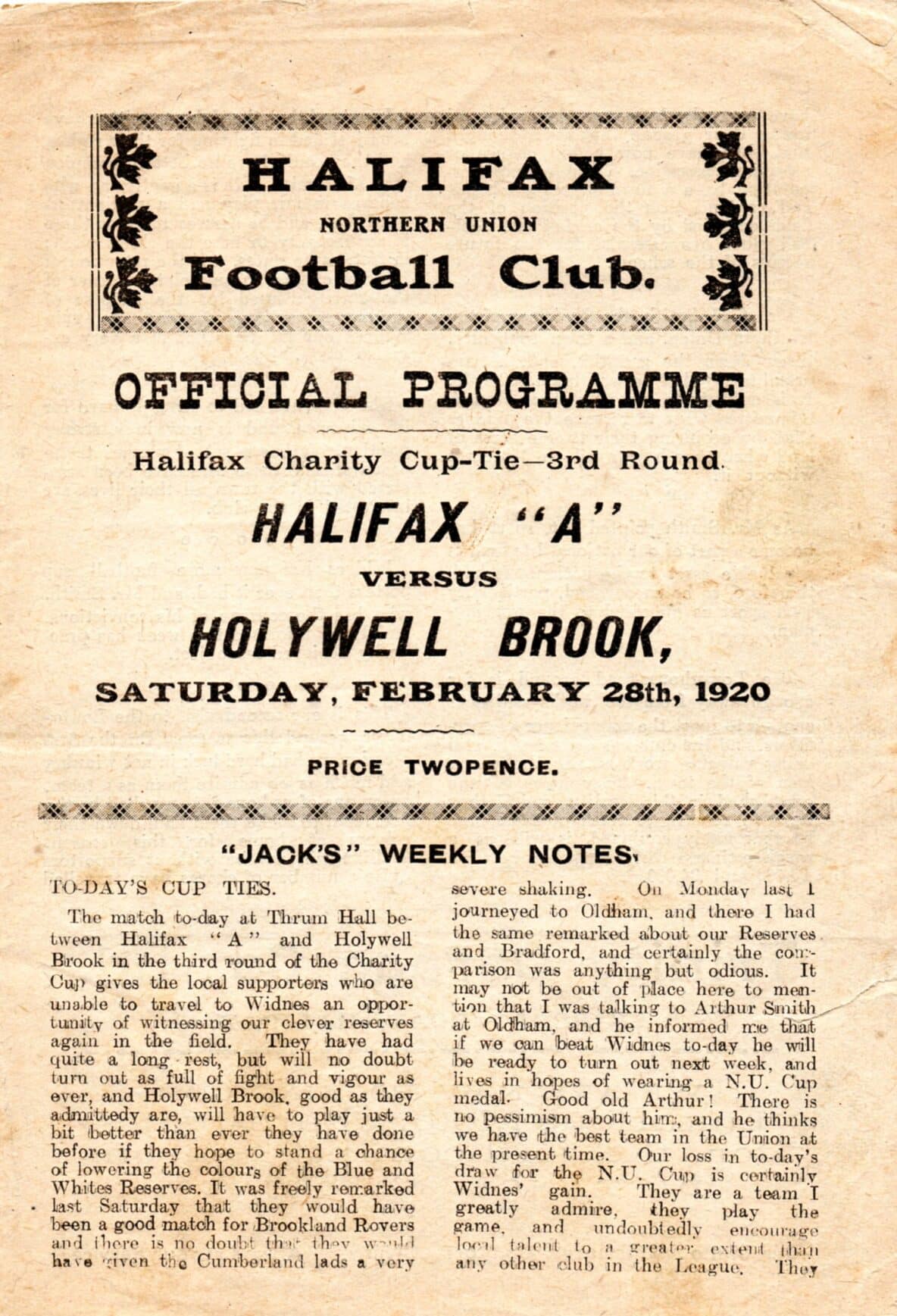
Holywell Brook were lucky enough to be drawn against Halifax “A” at Thrum Hall in the third round of the Charity Cup in 1919-20, giving them a share of good gate receipts. In the programme notes their representative said, “We have one or two really good players, and I say this without boasting that we have had quite a number of Northern Union agents down watching our lads. Hunslet took Furness away from us just when we were getting a good team together.” They merged with Holywell Green Athletic, who played at Church Lane Fields, to run a team in the Intermediate and Under-17 Leagues and continued to figure intermittently over the next decade.
Sowerby Bridge West End were new to the league, but had been playing friendlies earlier while struggling to find a suitable ground. They found one on the hillside beyond Triangle Station and were good enough to win the Intermediate League in season 1920-1, after which they were able to secure the former Free Wanderers ground at White Windows. A building already beside the field was converted into dressing rooms. They were to continue until 1928, by which time the White Windows ground had been lost to the building of the Beechwood estate, also joining the Rochdale League in the mid-twenties to the annoyance of the Halifax League. Other Sowerby Bridge teams also appeared in the 1920s – Sowerby Bridge Central (1921-4), Sowerby Bridge LMS Railway (1926) and Sowerby Bridge Rovers (1929-31).
Ovenden St George’s were connected with the church at Lee Mount. Most of their players were in the 16-18 age range, so the Intermediate League was quite tough for them to start with.
The 1920s turned into a productive period for leagues generally. At the start of them there had been some talk of uniting the Halifax and Huddersfield Leagues, but teams increased and it became unnecessary. Those 42 clubs across the whole game in 1919-20 had multiplied to 318 in 1924-5 and to a peak of 324 in 1929-30. In the Halifax League Rastrick and Pineberry were leading clubs, but top dogs were still Elland Wanderers, who twice won through to play high-flying Oldham in the Challenge Cup in 1920-1 and 1921-2, earning a share of gate receipts of £582 (the equivalent of over £30,000 today) from a 12,000 crowd at Oldham in 1921. In 1922 they were drawn at home at Old Earth, where the crowd limit was set at 8,000. Though they inevitably lost both, they were not disgraced. Their star player at this time was hooker Cyril Halliday, later to have a long professional career with Halifax, Huddersfield and Keighley.
In the younger age divisions were an evening school team called Halifax R.E.S. Gymnasium (based at Spring Hall), plus Carlton Rovers (from Highroad Well, playing at Roils Head) and Smith Bulmer’s. The latter, worsted spinning mill and dye house at Holmfield Mills in Ovenden, lasted only a short time, as did the others. Under-17 teams included Prospect Juniors from West Vale, Copley (who had started out on the land next to the cricket field which is now the clubhouse and car park), and two who rented fields at Savile Park – Bolton Brow and Crossley’s. There were also new teams called Halifax Amateurs, and Mount Pleasant from Southowram, who both shared fields with Beacon Rangers. None of these lasted long either.
Siddal reappeared in 1922 alongside Calder Valley and Hipperholme & Lightcliffe, and later there were Sowerby Bridge West End and Stainland. Southowram figured briefly in 1924, then in 1925 Lindwell, Windhill (based in Shipley), Catherine Slack again and a Todmorden team called Bourillion. North Ward, Lindley, Woodland Rovers, Castle Rovers, Holywell Brook, Tramways & Electric, army team 4th Dukes and a resurrected Todmorden were other names on the list, with Huddersfield-based St Mark’s and Hillhouse & Birkby. North Ward were connected with North Ward Conservative Club at New Bank, but could only find a ground at Mount Tabor.
Calder Valley were a new team formed in 1921 out of the ashes of the old Hebden Bridge club which had ceased operations at the outbreak of war in 1914, put together by former players and followers of that club. However they played in Mytholmroyd, first at Stocks Hall then at White House Holme with dressing accommodation at The Elephant and Castle Inn, Hawksclough. They used mostly players from the village soccer team to start with, but after the soccer team died out they became a force in local rugby with a strong fixture list. They joined both the Halifax and Rochdale Leagues, the matches in Halifax not being sufficient to provide a full programme, but fared well, winning the 1923-4 Championship Final at Thrum Hall by beating Elland 2 points to Nil. They built dressing rooms at the ground at a cost of £116 (£6,000 today) in the summer of 1924, formed a second team and organised their own Workshops competition. They went on to reach several more Halifax League Championship play-off finals, often losing out to fellow big-guns Rastrick, but won again in 1928-9, then in 1930 won the Halifax Cup, after finishing top of the league table. It was a shock to outsiders when they folded in 1931, an absence of home fixtures for weeks at a time being cited as the reason for a shortage of funds.
Stainland made a re-appearance in that village, figuring on and off until the Second World War. They beat Siddal in the Intermediate Championship Final at Thrum Hall in their first season, 1927-8. They used the Mechanics Institute as changing rooms, and produced future professionals in Albert Rawnsley and Ernest Norcliffe for Halifax, and Eric Swallow for Huddersfield. Norcliffe had earlier played for Barkisland, a junior team in the league from 1924 to 1926; he starred when they reached the Courier Bowl semi-final in 1925.
Bourillion, from the Eastwood area, had been a soccer team but changed to rugby in 1925, finding a field at Haugh Tops. They only played for a short time, as members of the Rochdale League as well as Halifax and later switched back to soccer. There had been no team in Todmorden since 1914 but suddenly there were two close together when Todmorden reformed, sharing Eastwood cricket field, which was the next field to the present-day Bridgeholme Cricket Club. Like Bourillion, they joined both the Halifax and Rochdale Leagues, but their stay too was to be brief. They moved ground to Rough in Langfield for the 1928-9 season but had closed down by 1931.
There was also in the early 1920s a Red Triangle Northern Union League for Under-17 teams, instituted in connection with a YMCA Boys’ Hut in Commercial Street. Siddal, Westbourne (playing at Savile Park), Trafalgar Inn, Caddy Field, Godley and Halifax Baptists were early contestants. In 1921 Smith Bulmer’s beat Carlton Rovers in its championship final at Thrum Hall, then in 1921-2 it had two divisions, featuring teams from these two, plus Lindwell Juniors, Pellon Juniors, Ripponden, Westbourne, Sowerby, Broad Street, Sowerby Recs, Whitleys, Halifax Rovers and a team actually named Red Triangle, sometimes referred to as YMCA to avoid confusion, who used a ground at Pellon New Road. There were also Red Triangle Leagues in soccer and cricket which operated for much longer, but the rugby version was incorporated into the Halifax & District League in 1923, becoming its Division 3, similarly for Under-17s. Sowerby Bridge West End were the first winners, beating Red Triangle in the championship final. As the decade moved on this division was joined by North Dean, Holywell Brook and a number of different Lads Club teams.
In Division 2, the Intermediate section, competitors included Howson’s, Beacon Rangers, Stainland, Halifax Crescent, Sowerby Bridge Central, Brunswick and Gledhill’s, and afterwards Elland Lane and Milton Rangers.
These Division 2 and 3 teams also had the Courier Cup, Courier Boys Cup and the Courier Bowl to compete for. The Courier Cup for the Division 2 Under-21s, was won in 1922 and 1923 by Sowerby Bridge West End, who beat Stainland and Beacon Rangers respectively. Lindwell, Pellon, Stainland and Sowerby Bridge West End again were other 1920s victors.
The Courier Boys Cup was won by Smith Bulmers in 1920-1, and Red Triangle in 1921-2, both on Ripponden’s ground. The 1923 Final was at Thrum Hall, Red Triangle retaining the cup by beating Copley.
Later in the decade there was a new team at Luddenden, at first known as Luddenden & Midgley, who fielded junior-age sides at Top Shuttles, before establishing an open-age team, at first in the Keighley League, and moving to Mytholmroyd. Also formed was a Halifax Supporters team; Supporters’ Clubs appeared in many Rugby League towns in the 1920s, Halifax’s starting in 1923. They initially arranged matches against youngsters from other Supporters’ Clubs, but afterwards also played local teams. In 1928 they met North Dean in a junior Halifax Cup Final at Thrum Hall.