Chapter 10. 1930s More Difficulties
Problems for the Halifax Junior League got worse before they got better. There was no league at all at the start of the decade. There are Courier references to the “moribund state of the junior game in Halifax”, and “junior football is almost at a standstill”. Elland Wanderers had another rebirth in Rugby League in 1930, joining Rastrick in the Huddersfield League, but the Old Earth ground rent proved a big obstacle and they fell apart in season 1931-2. Siddal, by now on a field at Backhold Lane, took over their fixtures, grateful to find opposition. Calder Valley operated in the Rochdale League but Stainland were reported to be out of action. Soon only Siddal were left and it was primarily at Intermediate level that the game continued in Halifax, where Siddal, Holywell Brook, Hebden Bridge Juniors (playing at Mytholmroyd), Halifax Hornets (at Pellon) and Sowerby Bridge Rovers (at Beechwood) joined Rastrick and Huddersfield-based Leeds Road (though said to be using players formerly with Holywell Brook) and Honley. For these junior teams there was still a Courier Cup – Leeds Roads beat Siddal in the 1929-30 final – and local qualifying rounds for the Yorkshire Intermediate Cup – Stainland met Siddal in 1930-1 to determine which Halifax team would progress.
The Halifax Charity Cup competition was inevitably in disarray. Rastrick had been its most regular winners during the 1920s, but it could no longer function as in earlier years. In 1928-9 it was contested by Featherstone Rovers “A” and Castleford “A”. Calder Valley won it in 1929-30, but the following year it was intermediate sides who took part and then, with interest waning further, it became just a single match between two invited teams.
Without too much competition, Rastrick had become the leading side in the area, though still playing as much in Huddersfield as Halifax and using players based in Huddersfield and Dewsbury as well as Brighouse. It was they who took home the Halifax Charity Cup three years in succession between 1933 and 1935, having been regular Halifax League champions since 1920. By the 1930s they had lost their long-time home ground to Brighouse Corporation for the creation of a playground, so had moved to share with New Road A.F.C. at Crowtrees on Carr Green Lane (now Wentworth Court), where large crowds would follow their fortunes. Changing accommodation was at the Thornhill Arms. Their long direct involvement in the Halifax league was to last until 1949, the club continuing for another twenty years after that in the Huddersfield League.
It was hoped that a workshops competition would do some good again. One had started in 1929, won by Siddal Old Boys, and certainly provided renewed interest. Mackintosh’s were to become four-time finalists, while Pellon Old Boys (1930), Cross Keys at Siddal (1933), Ram’s Head at Sowerby Bridge (1935) and United Services (1937) were other winners during the next decade. Paton & Baldwin’s were one entrant who actually went on to join the league, but the others were happy to stick with just the workshops and friendlies. Having to come up against the town’s leading sides would have appeared daunting.
Attendances were not that great, the 1938 final between Vowles Combination and United Services drew the most at 1,200, but then in 1939 almost 7,000 were present for the Rawdon & Weavers (Luddenden Foot) versus Hartley & Sugdens encounter, a record for a junior match in Halifax. The explanation was that it was the night of Halifax RLFC’s triumphal return from winning the Challenge Cup at Wembley, followed by a Town Hall reception, the workshops final after that at 7pm. The Cup was to be on display in the stand, and captain Harry Beverley would present the prizes to the winners, who turned out to be Hartley & Sugden, so public interest was at a peak.
Something else needed to be done to regenerate the league – and was. The Yorkshire County RL were the instigators, forming a sub-committee in 1932 to meet officials of Halifax RLFC with a view to organising a new Junior set-up. A schools league came first, eleven of the contacted schools showing some interest. Battinson Road, Wainstalls & Mixenden, Lee Mount, Sunnyside, Haugh Shaw and Parish Church were the teams to take part. At the same time the Courier Bowl was turned into a schoolboy cup competition. Battinson Road and Holy Trinity regularly reached finals, as did Haugh Shaw and St Joseph’s. It continued into the war years, matches often being played at Ling Bob Farm, before the school was built there, and Manor Heath.
Then by November an Under-21 section became the target, the aim being to form a skeleton league before Christmas. The school leaving age was still just 14, so there were plenty of lads around looking to continue with the sport they had started at school. Some actually labelled themselves as Old Boys, as did lots of Rugby Union teams.
Pellon Juniors, Beacon Rangers, Belle Vue, Halifax West End, Warley Old Boys, West Vale (at Hullen Edge) and Lindwell (formed after inviting all youngsters from West Vale and Greetland to a meeting at Lindwell Methodist Sunday School) were the new or reformed clubs to join up. Belle Vue changed their name to Park Rangers, outgrew themselves and split into Park Rangers and Park Rovers, playing at Denfield in Wheatley, but both were gone by 1933. Stainland were back in there with Luddenden and Paton & Baldwin’s, while there was a fleeting reappearance of Sowerby Free Wanderers, now on a field at Mill House Lane, Triangle. Sowerby Bridge Hornets (at Sterne Mills), West Mount Rovers (at Mount Tabor) and R.E.S. Gym (at Spring Hall) also came in. The returning Pellon Juniors briefly found a convenient home in Moor End Road, but were back at Norton Tower by the time they dropped out again in 1935, though they were to make a short appearance in the Under-18 league in 1938-9 on the Roils Head field nearest the paddock, at the top of Paddock Lane.
From virtually nothing, Halifax soon had a rapidly growing league with more teams than many other areas. The following season Siddal returned from the Huddersfield League, Rastrick became involved as well, North Ward (“The Warders”) had a team and Sowerby Bridge Hornets joined. Mount Tabor and Ripponden followed in 1934.
Mount Tabor were formed by District League secretary W.Hitchen in August 1933 to play on the ground used by West Mount Rovers, a sloping pitch near the dressing rooms at the New Inn (now Spring Head). They fielded an “A” team as well, but only lasted a couple of seasons.
Warley Old Boys, thought to be ex-pupils of Warley Road School, played at Edgeholme Farm in Warley and near the Friendly Inn on Burnley Road. They featured in the 1933 Charity Cup Final at Thrum Hall against Rastrick.
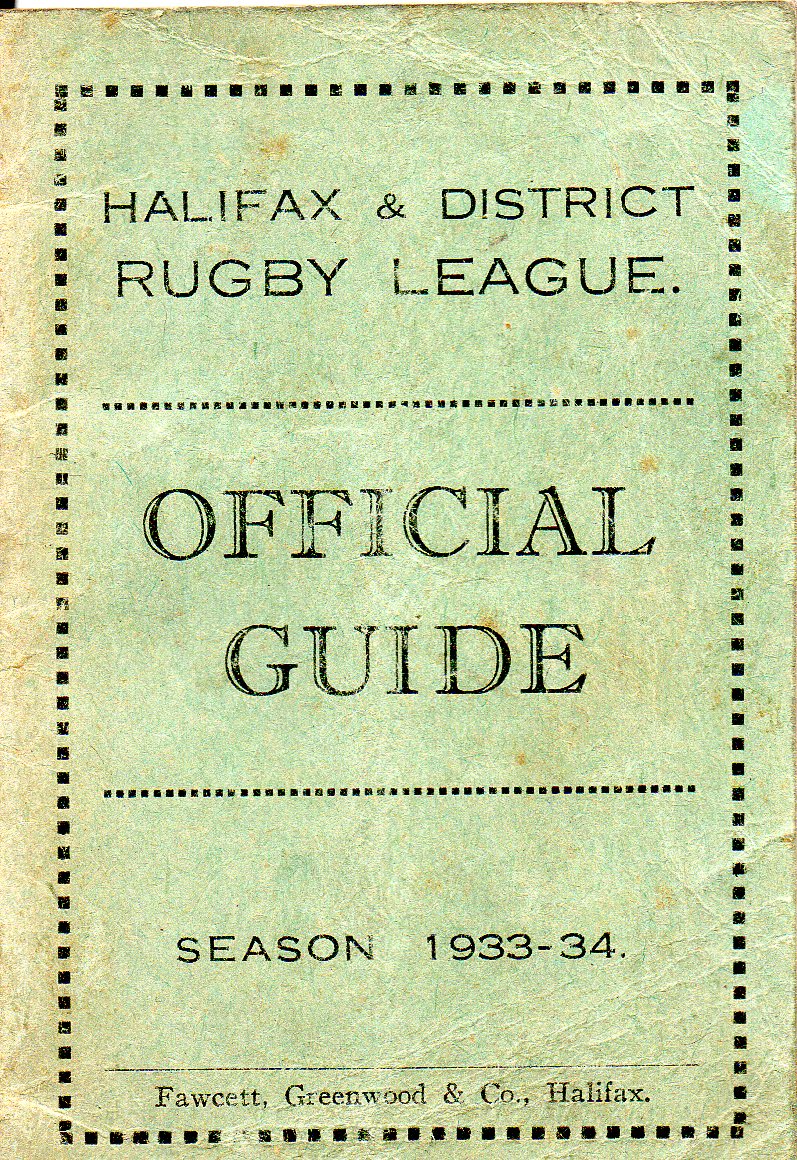
This was all still at intermediate level and below. A surviving league handbook from 1933-4 lists all the clubs that season, with their grounds and dessing rooms. There were none in the open-age section, but fourteen in the Under-21s. Halifax West End were at Tower Hill (Norton Tower), changing at the ground, Lindwell were at Lindwell Recreation ground, changing at Lindwell Methodist Church, Luddenden at Seedhills, Midgley, changing at The Travellers Rest (Midgley), North Ward at High Sunderland, Paton & Baldwin’s at the Denfield Arms Inn, Pellon Juniors at Moor End Road, changing at The Fountain Head Inn, Rastrick based at the Thornhill Arms Inn, Sowerby Bridge Hornets at Sterne Mills and changing at the Navigation Inn at Bolton Brow, Stainland at Stainland Rec , changing at the Bull and Dog Hotel, and Warley Old Boys at The Astley’s, Tuel Lane Top, changing at the Friendly Inn, Burnley Road. A Bradford team, Hall Lane White Star, completed the line-up, with a ground on Tong Street, Dudley Hill. Under-18 sides Lea House (at Denfield Arms) and Sowerby Free Wanderers (at Sterne Mills) played alongside fellow-youngsters from West End and Luddenden. Lea House from Wheatley were Under-18 Championship winners in 1932-3 and 1933-4.
Halifax West End, so titled to differentiate them from Sowerby Bridge West End, were the champions that season, beating Stainland in the play-off final. Based near West View park, they remained a top team for another couple of seasons, being crowned champions in 1932-3 and 1934-5, and appearing in the 1934 and 1935 Charity Cup Finals as runners-up. As well as Tower Hill, they also played a season at Pigman Lane, Warley, but dropped out in September 1936 when unable to find enough players.
Nearby Highroad Well, connected with the Congregational church there, formed an Under-17 team in 1937 which had become Under-21s by season 1939-40. Their ground was the exposed Isolation Field at Roils Head. The Courier’s correspondent “Oval” visited for a match on a wet and very windy day in January 1938; he missed the bus and took the tram to Highroad Well, from where he walked. “Eventually the ground was reached after an experience unsurpassed during my sixteen years on the job,” he rued. There were several pitches at Roils Head, but at this time no baths for the players.
Smith’s Wireworks showed interest in forming an open-age side in 1934 and there were hopes of King Cross, Sowerby Bridge, possibly the Arden Road Artillery, along with Bradford-based Dudley Hill and Wyke, but nothing materialised. Smith’s Wireworks played in the Workshops competition that year instead. When international amateur rugby league launched in 1935 following the spread of the game to France, there were no local open-age players around to be considered, a shame when the 1936 fixture was played at Thrum Hall.
Season 1934-5 brought the arrival of the second modern-day club with the establishment of a new Greetland club who became Greetland All Rounders after the Second World War when they amalgamated with Elland Olympic Weightlifting Club. Neighbours Lindwell were going well at the time and young lads from higher up at Greetland were unable to get in the team and indeed felt unwelcome because they were not Lindwellers. So a group of 13-16 year olds from Cross Hills formed a team of their own to play on a field at Moor Bottom, with changing rooms at the Conservative club. They intended to find fixtures at Under-16 level, but despite their young ages soon moved on to the Under-21 Intermediate League. By 1937 they were meeting Lindwell in the Courier Cup Final at Thrum Hall, though Lindwell won the derby 11-0. Greetland made up for it by winning the cup in 1938 and 1939, both finals against Elland.
The Courier Cup had become a mainstay of the Under-21 league, won by Siddal (twice), Rastrick and Lindwell earlier in the 1930s, but was ended when the Second World War started, never to return.
Greetland held their own over the remainder of the 1930s, alongside Luddenden, Siddal, Halifax West End, Ripponden, Lindwell, Dean Clough and Mytholmroyd. The latter were new in 1935, being put together by an ex Calder Valley stalwart, while Dean Clough were from the carpet mills, who operated teams in a variety of different sports, including Rugby Union, from their base at Moss Cottage, Illingworth. Luddenden Foot and Elland were back on the scene in 1937, but there was still very little open-age football. By the late 1930s the two sections were referred to as Under-21 and Under-18, with nothing for over 21s.
Rams Head (Sowerby Bridge) emerged as a force in this group, renaming themselves Ram’s Head Green Label Juniors for a time, and having the honour of playing in a curtain-raiser to the 1939 Challenge Cup semi-final at Odsal. Many of their players went on to join the Albion Rams side based at Claremount’s Albion Hotel, who played at High Sunderland. There was also a team at Northowram, a Territorials team connected with the Duke of Wellington’s Regiment, and Halifax Imps, a political organisation from the Halifax branch of the Junior Imperial League. In 1939 there were Boys’ Brigade old Boys and St Paul’s Scouts, while Beacon Rangers returned, sharing the High Sunderland ground.
Lindwell were gone by then, having met financial difficulties, many of their players joining the new Elland junior team at Hullen Edge, with headquarters at the Fleece Inn, who became well-established. They finished runner-up to Greetland in their first Intermediate league season and in 1938-9 won the Halifax district final of the Yorkshire Intermediate Cup.
Luddenden Foot formed a new team in October 1937 to join neighbours Luddenden, though the latter soon afterwards withdrew. They settled at the old Brier Hey ground in Mytholmroyd, once used by the Mythlmroyd club, though midweek training was from the General Rawdon pub in Luddenden Foot (later renamed Coach & Horses). They became successful; forwards Round and Roberts had trials with Halifax “A”, full-back Schofield went to Rochdale Hornets, while Roberts and Bradley played for Yorkshire County Juniors. They formed an open-age team in 1938-9, which necessitated joining the Keighley League alongside Queensbury, and ended up winning it. “The forming of an open age side at Luddenden Foot has been a great success,” wrote the Halifax Courier, “and has given players the opportunity to carry on their rugby activities. It may lead to an open-age league being formed in the Halifax area next season.” But events were to get in the way of that.