Chapter 12. Post-war strength
The local league had struggled at open-age level for many years, so immediately looked to expand beyond their own boundaries when it came to organising rugby for the post-war 1945-6 season. Kitchen & Wade’s retained their team, but there was to be no immediate return yet for Siddal, Ovenden, Greetland or Luddenden. Instead interest came from a new team, Asquith’s Engineering Company at Highroad Well; they played on a field in Warley behind the Maypole Inn for a while, but were later at Roils Head. From Leeds came Buslingthorpe Vale, from Keighley were Keighley Athletic, and from Bradford were Bradford Northern Juniors and the Jack & Jill club based at Odsal. Buslingthorpe Vale were both league and cup winners.
Under-21 leagues faded from the scene with the introduction of National Service after the war; all able-bodied men between the ages of 18 and 21 were expected to serve in one of the armed forces for eighteen months, later extended to two years, until the early 1960s. Instead there was an Under-18 league. Siddal were in there alongside Queensbury, North Mount, YMCA, Hebden Bridge, Luddenden and two teams from St Mary’s. North Mount were a Boy Scouts team, described as “a promising Halifax Junior Rugby League team” when pictured in the Courier in February 1946, but they only lasted the one season. Queensbury on the other hand, who had been formed in 1937, became well-established, though they figured primarily in the Bradford area rather than Halifax. In this period they played at Foxhill Park on Fleet Lane, described then as a windswept patch with extensive views, close to their modern-day location in Albert Road.
Matches were also played on Monday nights at Thrum Hall for youths aged Under 16, there being teams from Siddal, Pellon, Queensbury, Luddenden, North Mount and Battinson Rovers. And there was still schoolboy Rugby League, the 1946 Cup Final of which was between St Joseph’s and Battinson Road in a Thrum Hall curtain-raiser to the match against Wigan. Those schools also in action by 1948 included Ovenden, Sunnyside and Siddal, but also Crossley & Porter, where ex-Bradford Northern international centre Jack Kitchen was a P.T. teacher for a time. In 1949 Crossley’s reached the Schools Cup Final where they were beaten by Battinson Road at Ling Bob. Subsequent 1950s finalists included St Joseph’s, J.H.Whitley’s and Exley. The Courier Bowl was also contested again, Clare Hall winning it four years in succession. Clare Hall additionally won the Yorkshire Schools Final in 1952, beating Southdale at Crown Flatt, Dewsbury. Further, Halifax youngster Denis Hardy captained Yorkshire Schoolboys against Cumberland in 1952. But by the 1960s schoolboy rugby league in Halifax was in decline, not helped by secondary schools, where it was traditionally strong, becoming comprehensive schools.
Greetland All Rounders and Ovenden were back for 1946, with Rastrick, Elland and Queensbury and the out-of-town teams, plus a new club at Southowram. Based at the Pack Horse on Cain Lane, they provided themselves with a stoutly built pavilion where facilities were available for indoor training and from where refreshments were dispensed on match days. The ground was usually in West Lane, but they also played at Fairfield in Pinnar Lane, before withdrawing in 1952.
Elland were a continuation of the pre-war Elland Juniors, formed in 1937, who had been successful Huddersfield League Under-21 contenders during the later years of the war. They were still based at Hullen Edge, and continued until resigning from the league late in the 1954-5 season. Among their star players was Jack Fairbank who joined Huddersfield aged 18 in 1951 and went on to play for Leeds in the 1961 Championship Final. His sons David, Karl, Mark and John were later to excel in another incarnation of Elland Rugby League in the 1980s. Jack was himself following in his father’s footsteps, Frank Fairbank (ex Calder Valley) having been a hooker with Halifax and Broughton Rangers.
Hebden Bridge were a new team to the open-age set-up in 1947, based at the former Calder Valley club’s ground at White House Holme on Burnley Road in Mytholmroyd, part of which is now a petrol station. The changing rooms were converted terraced houses on the roadside. Hebden Bridge became a successful team, reaching the local cup final in 1952-3, then again in 1964 and 1965. They were the only Calderdale club to go to the trouble of producing a year book. Their star product would be full-back Gerry Round, who won international honours in his first season with Wakefield Trinity in 1959-60 and was picked for them in four Wembley Cup Finals. Just as famous, though not for Rugby League, was a young Bernard Ingham, who later became a noted political figure as Margaret Thatcher’s press secretary. Hebden Bridge hit controversy in 1958 when they selected two New Zealanders, Donald Rainbeck and Keith Graham, who turned up asking for a game. Other clubs objected and the RFL ruled that overseas players were not allowed without clearance from their country.
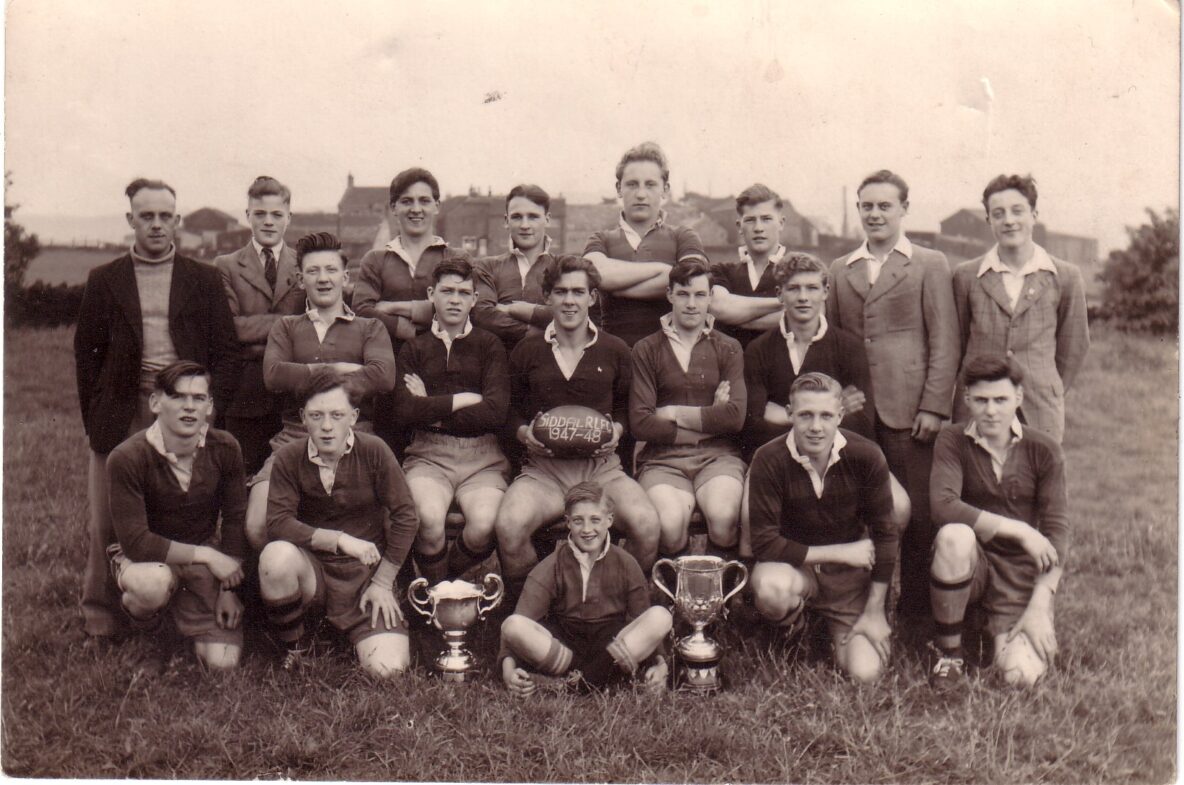
Luddenden had been formed before the War as Luddenden Foot, renting a field at Top Shuttles (or Top Shutts) down Naylor Lane at Midgley, and playing in the Under-21 and Under-17 leagues. They were back in action by 1947, reaching the Under-18 Cup Final at Thrum Hall that season, but losing out to Siddal after a replay. They progressed to the open-age section, now on Midgley Rec with headquarters at the Travellers Rest nearby. They generally did well, notable players including the Callighan brothers, Trevor and Eric, and Frank Cox. Frank’s brother Jack, a Halifax player at Wembley in 1939, had been one of those heavily involved in their revival.
Claremount Rangers were involved from 1947 to 1951, at open-age and Under-18 level. They were based at the Albion Inn, with a ground at nearby High Sunderland.
The Pellon name was back in 1948, now without the Juniors tag. They fielded both open-age and Under-18 teams and were to continue until 1956, in reality with little connection to earlier Pellon teams other than using the same Roils Head field. Although they were not major trophy-earners, they did produce a remarkable number of future professional players, notably future Halifax championship winning captain and Yorkshire county centre John Burnett, along with Gordon Leeming, Brian Vierod, Roy Pollard, David Sykes and Jimmie Lawton.