Chapter 4. An early crisis
At this point everything in the area seemed rosy. Halifax and Brighouse Rangers were in the top flight performing well, while five local teams – Sowerby Bridge, Hebden Bridge, Todmorden, Elland and Luddenden Foot – were in the second tier. The new Halifax & District League had annexed almost all the former local Rugby Union teams and seemed well set. But it was all about to go wrong.
The five second division clubs began to fall apart. Elland were the first to go in 1900. They were still being successful on the field, but financial issues and waning interest from their officials at Old Earth brought a surprise decision to disband. A splinter group organised a last-minute meeting of local junior clubs Stainland and Holywell Green, who had also just folded, plus West Vale Rovers who still played and long-defunct Greetland, to amalgamate into a new Elland and cling on to the second division place, but there was no enthusiasm for the plan and it fell through.
Luddenden Foot collapsed soon after the start of the 1900-1 season, unable to raise a team for the fourth match after defeats in the first three. They were initially suspended, but then withdrew. Both Sowerby Bridge and Todmorden ceased operations in 1903, followed by Brighouse Rangers in 1906 and Hebden Bridge in 1907.
The game as a whole, not just in Halifax, had got itself into difficulties. Clubs like these, who had come over from Rugby Union, ceased to be strictly amateur clubs, and soon started to struggle in their new environment. For them, finances became an issue, often caused by payments to players. This wasn’t unforeseen – indeed the original rules of Northern Union prevented wages. “Broken-time”, or compensation paid for lost time at work in order to play, was allowed from the start in 1895, but more general semi-professionalism was permissible from 1898. There was no compulsion to pay it, but the better players might have expected it and clubs might have felt a need to pay it to attract better quality. Halifax themselves got into difficulties, despite being a successful team, their debt by 1900 standing at £600 (the equivalent of £60,000 today).
For the senior clubs in smaller villages who might have been paying broken time or small wages, the problems were even worse. By comparison with Halifax their debts seem almost trivial – Elland’s were reported as £60, Hebden Bridge’s the same and Todmorden’s just £4 – but for them the crowds did not roll up in big enough numbers to give them hope for the future, or cover on-going costs. There was never really much chance that they would. If IMG had been around, they would have awarded them zero pints for catchment area. And also not many points in every other category. They would all have fared better in the local league.
The same problems did not affect the junior clubs, who would have had no thoughts of paying players. Yet they too hit difficulties, for different reasons. The new Halifax & District League never really got going. In 1901-2 it was down to six clubs – Cross Stone, Duke of Wellington Regiment, Glen View, Halifax Crescent, Stannary (playing in Shroggs Park, where a team known as Halifax Thornes had earlier been based)) and Lee Mount (headquarters at the Broad Tree Inn). As well as Stainland, who had lost good players to the Halifax and Huddersfield semi-pro clubs, the likes of Ovenden, Bradshaw, Hipperholme and Ripponden were no longer involved. Todmorden “A” had obviously disappeared at the same time as their first team, and Todmorden Church had gone; many of their remaining players joined Cross Stone who moved to the Rochdale & District League along with Glen View, though they did not survive for long either. Players from the defunct Elland joined Elland Free Wanderers who, thus strengthened, won the Halifax Cup in 1900-1 and had similar success in the Huddersfield & District League, winning the league and cup there, but they too were to disband in 1902, seemingly fearful of the future in the face of falling subscriptions and player commitment.
By 1902-3 there was no local league at all functioning in Halifax. The one club keen to carry on, Halifax Crescent, ambitiously joined the Yorkshire Combination, but it ended in tears. They found the opposition too difficult and the travelling expense too high, and withdrew in October soon after a 58-0 defeat against Halifax “A” and a 27-0 loss to Thrum Hall. They continued with friendly matches but soon folded after a 14-year existence.
The decline would have come as a surprise. Rugby had been all the rage for 25 years but now the boom years had gone. Locally, senior club Halifax could in 1902-3 legitimately claim to be the best rugby team in the world, for in that season they had won both the League Championship and the Challenge Cup, and were to retain the Challenge Cup in 1903-4. Such success should have heralded more interest in the game not less, though some potential players might have preferred to watch such a successful team on a Saturday afternoon rather than play in matches that clashed.
Whilst it might seem Northern Union had made a mess of things, this wasn’t the case, for the other code lost even more teams. All the junior Rugby Union clubs had ceased playing by 1900 and the one senior club Mytholmroyd also fell by the wayside in the same period. With poor attendances Mytholmroyd decided they would be better off playing soccer and packed in the rugby. The soccer team were to continue until 1923.
Therein lay the biggest issue facing Northern Union. Soccer had become a major counter-attraction, especially in Halifax and the Calder Valley where previously it had been very low-key. There was still no professional team – Halifax Town were formed in 1911 and joined the Football League in 1923 – but amateur soccer was growing. 1903 saw the birth of the Halifax Saturday League, though there had been earlier ones. Initially it consisted of just six teams but grew to become one of the largest amateur association football leagues in England. Also recently started were a Salterhebble & District League, a King Cross League, an Akroyden League and a Sunday Schools League. “There must now be over a hundred Association clubs in Halifax and district,” wrote a letter-writer to the Courier in 1905. In Todmorden, Cross Stone became the only rugby team of note – and they soon packed in too as soccer took hold.
Junior league soccer teams now competed not just for players but also for grounds. The field at Exley, used first by Salterhebble and later by other Siddal-based clubs, was lost when Halifax Town outbid them, but there was competition from amateur soccer teams for lots of others, including those on The Moor. Soccer needed fewer players and rules were simpler. For schools there were less complaints from parents about dirty knees, ripped clothing and injured bodies if they concentrated on soccer rather than rugby.
Soccer and rugby at this time were more similar than they are now. Players could fairly easily swap between the two, even at the very top level where the pay was also similar. Halifax’s international winger Percy Eccles had joined the club from Elland Rams soccer team and later left for a time to spend a season with Bradford Park Avenue. He openly said he preferred playing soccer as he got less knocking about. Others, like Clem Garforth and Joe Chadbourne, turned out for both Halifax Town and the Thrum Hallers during their careers.
Despite all this, local Northern Union kept going. Although there was no local league, there were still teams playing in the area. Thrum Hall and Salterhebble were still in higher leagues, while operating in the Huddersfield & District League at various times were Brighouse St James, Rastrick, Brookfoot and Elland Free Wanderers, joined in 1903 by Salterhebble when they opted to step down from the Yorkshire Combination.
Brookfoot F.C. won the Huddersfield Holliday Cup in 1902-3 and 1903-4 when based on an eccentrically-contoured field near their Wharf Inn headquarters, but moved to share with Brighouse Rangers at Lane Head to help with the annual £70 ground rent there in 1904. They entered the Halifax Charity Cup that season, losing to the eventual runners-up Salterhebble, but didn’t last much longer, the Huddersfield League following their Halifax counterparts into hibernation in 1906.
Brighouse St James (“The Jimmies”) and Rastrick were the two other rival rugby clubs operating in Brighouse alongside Rangers, both fairly long standing. St James played at The Lees with a good fixture list that included Halifax “A” and had prominent players in Alty Farrar and Harry Schofield who went on to have significant semi-professional careers with Rochdale Hornets and Bradford respectively. They bought Rangers’ posts when they disbanded, but were to close themselves in 1908 with financial difficulties, their ground being taken over by a soccer team.
Rastrick were the Brighouse-area team to prove the most resilient. They moved grounds again around this time, from Lower Cote to a better one at Slade Lane, near where they had originally started out at Round Hill, their headquarters becoming the Round Hill Inn, Clough Lane. They lost star player Charlie Ridsdale to Dewsbury in 1907, but recruited former Wakefield Trinity and one-tine Brighouse Rangers winger Charles Baker and performed well in the Huddersfield League, which was soon revived.
For season 1905-6 Salterhebble, Thrum Hall and Hebden Bridge (playing at Calder Holme) had joined the Bradford and District League. They were there again in 1906-7, now alongside Halifax “A”, Brighouse St James and Rastrick. Halifax “A” won its Eastern Division this time round, but lost to Western Division leaders Victoria Rangers in a play-off. The prestigious Halifax Charity Cup, which had not been contested in 1905-6 because of the shortage of teams and lack of general interest in it, was actually handed over to the Bradford and District authorities, even though they had their own Charity Cup. There were still entries from Halifax, but teams from outside the area like Stanningley, Victoria Rangers and Slaithwaite Juniors became heavily involved in the next few years.
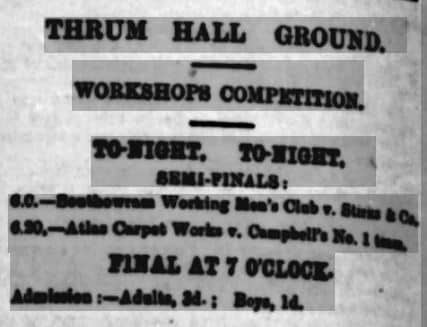
A major positive was that in 1903 the Halifax Cricket and Football Club began an annual workshops competitions, with matches played at Thrum Hall on midweek evenings twelve-a-side. It wasn’t a totally new idea, for there had earlier been such competitions in rugby and cricket elsewhere, including rugby workshops competitions at both the Sowerby Bridge and Todmorden clubs in 1902, but the Halifax competition was on a bigger scale. It offered a cup and gold medals for the winners, and provided kit for all matches (stripes v whites). It must have been exciting for workers in Halifax to be allowed on the field of their heroes, and challenge for medals. A total of fifty teams paid the 2s 6d entry fee, which totally belied any lack of interest in playing the sport, some entrants going on to form regular weekend teams. On Christmas Day morning in 1903 there was also a special match between Halifax Reserves and a Workshops Competition Select.
A team from Oates and Green’s, based at Beacon Brick Works at Ellen Royd, were to win it three years in succession between 1904 and 1906, that third one being celebrated with a social and dance at Claremount Liberal Club, where the medals were presented. The competition was to continue until 1909, the performance of Boothtwn Volcanic in that year’s final causing two of their players, winger Thompson and full-back Herbert Mitchell, to be signed on by the watching Halifax club officials, as had happened to Alec Thompson of Bairstow & Balmforth’s, winners in 1980. Thompson was to play a first team match, though neither of the others progressed beyond the reserves. That 1909 final was played at Thrum Hall as before, but other matches in that year’s competition had been at The Pheasant ground where attendances were lower, and it was to be the end of the line for several years.