Clubs > Illingworth > The 1970’s
The 1970’s
A new pitch at Tar Hill, just one farmer’s field over from the original pitch, was completed in the early 1970’s using the excess soil and rubble from the construction of the Abbey Park Housing estate which was happening at the time. The changing rooms were now close to the pitch in two converted World War Two air raid shelters, with showers! The work on the pitch itself made it level and floodlights were installed by the club players and members. Progress continued when an old wooden office block was purchased from local engineering company, Asquith’s, with the intention to us this as a clubhouse on site. Planning permission was sought. Sadly, this was not forthcoming and the structure was destroyed by fire before planning permission was granted.
The team was now meeting at the Talbot Inn which became the club’s official headquarters. Prior to this they had briefly been at the Commercial Inn. Peter Clayton explains that the Talbot became the centre of not only Rugby League for the Illingworth lads and their families, life revolved around it. The club had started a “double draw” to raise funds for the club and players went around Halifax selling tickets. The draw was the reason for being in the Talbot on a Monday evening.
“Monday was the Double Draw; Tuesday was training; Wednesday was committee meetings; Thursday was training night; Friday was a couple of pints to talk about the Saturday game and of course Saturday was matchday and drinks afterwards! Not forgetting Sunday which is when the team and supporters met to talk about the previous day’s game. ”
The social side of the Illingworth club was clear with the outings. In 1973, there was an outing probably to the races and the team and supporters are photographed outside the Talbot Inn. Peter Clayton’s wife remembers the day but not the outing as she was in hospital giving birth to their first child!
Peter tells of the great atmosphere of the Illingworth family.
“The club was full of characters: the team Joker was Martin Clegg. One trip to Hull, we stopped off on the way back at a pub. Martin started to go around the pub doing his “Eamon Andrews” impression and “This is your life” with everybody drinking there. Hilarious!”
In 1970, Illingworth had made it to another Halifax Cup Final at Thrum Hall winning with Gerry Slattery, who later at 32 years of age signed professional forms with Halifax, as captain. Gerry also recalls playing at Tar Hill as:
“even after all the rubble the pitch still sloped. And the boiler in the changing rooms had a mind of its own! It had to be lit a couple of hours before kick-off. Every home game, Douggie Main used to go light it. One day it was really snowing and we could see the single set of footprints in the snow where Douggie had gone to light the boiler!”
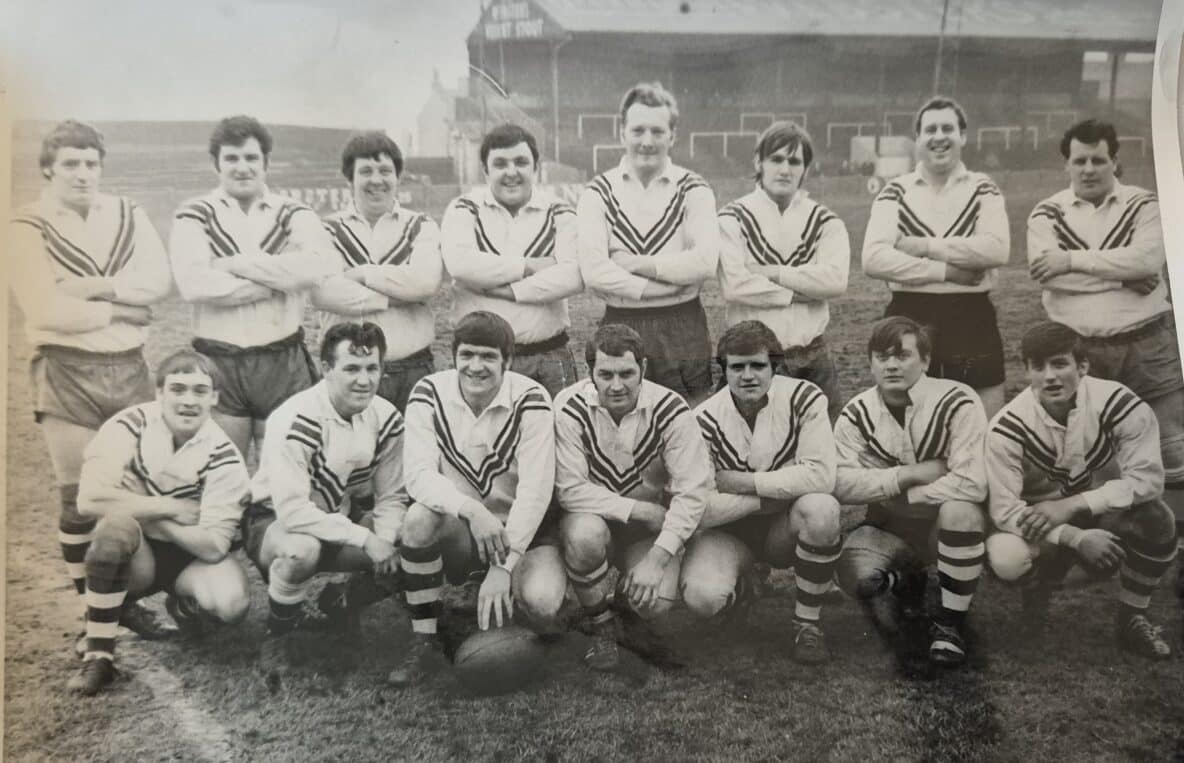
The 1971-72 season was a real success for the club. They won the Halifax Cup and Championship double. Two players, Gerry Slattery and Sam Illingworth were both selected for the Yorkshire team.
The club was growing strongly with Terry Dolly (ex -Oldham) as club coach and the decision was made to form an “A” team under the captaincy of Trevor Eastwood, as well as relaunching U17 side for the 1973-74 season.
The Illingworth first team had really improved and managed to reach BARLA’s first Yorkshire Cup Final in 1973-4 under first team coach, Stan Gardener. The game was against a strong West Hull side and took place at Thrum Hall, Halifax.
The Cup Final team was captained by Gerry Slattery who was at the time also a BARLA Great Britain international and many of the Halifax Catholic High School alumni provided the backbone of the Illingworth team. These included Brendan White, Brendan Finn, Paul Shaw, Paul Janciewz, Gerry O’Grady, Stan Gardner, Tommy McGivern and John Anderson to name a few. Luck was not on Illingworth’s side that day and they were narrowly beaten by a formidable West Hull side, who would go on the 1977-78 season under the name of Cawood go onto beat Halifax!
After being narrowly beaten by West Hull in that final, several players left the club including Gerry Slattery who signed for Halifax. and that void was filled by upcoming “A” team and junior players. Two of the players from the junior side also went on to sign professional forms: Brendan White and Brendan Finn. With these players leaving, the club needed a period of consolidation and appointed former Bradford Northern coach, Brian Smith.
For the 1974-75 season, Illingworth joined the new Pennine League in Division 1 finishing in 9th position winning just 10 of their 21 games which resulted in relegation for the following season. The club’s U16’s finished 4th in their league
In Division 2 for the 1975-76 campaign, Illingworth finished in mid table winning 12 of their 22 fixtures.
As the years passed, the fortunes of the Illingworth open age teams were not on the up as both teams struggled to find that winning formula. Once again the first team were relegated at the end of the 1977-78 season, when they failed to win a single game in Pennine Division 2.
The final season of the decade saw significant improvement for the Illingworth team. Gerry Slattery returned from the professional ranks and became player coach. The team finished a creditable 4th in Division 3 (15/22) which (surprisingly) resulted in promotion to Division 2. The success continued into the following 1979-80 season. Illingworth performed well on the pitch – only two defeats in their 18 league games – finishing top of Division 2 and were promoted for the second successive season. Gerry tells that he didn’t
“play too much generally coming on as substitute. I bobbied and shout where players should go.”
Tim Hardcastle, who started as a 16-year-old at the club and was a fixture at the club for many years, remembers travelling up to Millom in the National Cup
“we were not a great travelling team. We always seemed to be the bridesmaid and never the bride”.
Needless to say, the team returned empty handed from Cumbria.
And as the decade drew to its close, there was another disappointment this time on the planning front as a new design for a clubhouse at Tar Hill was again refused. The club continued its nomadic existence. This included going back to a series of several pubs for post-match refreshments as pubs were officially closed from 3pm until 3.30pm! The list included The Cross Keys (Siddal), the Brown Cow (Highroyd Well), the Stannery, and the King Edward VI.