The History

At the turn of the 20th Century formalised leagues were started around Halifax and one of these was the Halifax Sunday Schools League which was born around 1903. It was preceded by the Halifax & District School Sports Association (HDSSA) which was formed in 1901 to cater for the sports needs of schools. The competition to the Northern Union from local junior soccer leagues was intense not just for young players but also for pitches.
Junior league soccer teams now competed not just for players but also for where to play. Soccer needed fewer players and rules were simpler which from a schools’ perspective meant there were fewer complaints from parents about dirty knees, ripped clothing and injured bodies if they concentrated on soccer rather than rugby.
The first HDSSA record of school rugby was the May 1906 minute
“The Secretary is to communicate with school re. the desire for the adoption of Rugby Football (Northern Union Code)”.
The school leaving age was only 12 years of age until 1918 when it was raised to 14.
By 1913 although the open age league was strengthening, in Halifax Northern Union had next to no presence in schools. A saving grace was evening schools. With the school leaving age just 13 or 14 for most, youngsters up to the age of 18 often continued their education after work. It was the era when evening schools operated in day school buildings. One was at Siddal School, where a Northern Union team was established, moving on to join the Intermediate League in 1913. Although it was an evening school team to start with, it is the origin of the Siddal club we know today – the first of the present-day Halifax-based clubs to be formed.
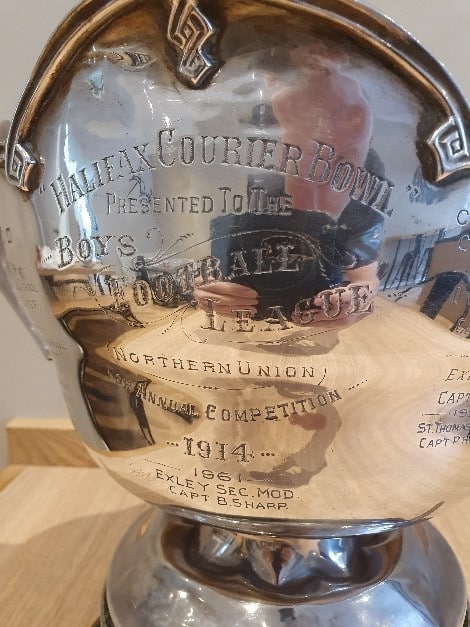 The Courier newspaper owners opted to encourage such youngsters and donated a “Courier Bowl” for an evening school competition; Siddal became its first winners on Easter Tuesday in 1914, beating Parkinson Lane Evening School at Thrum Hall, the losing semi-finalists being Akroyd Place and Lee Mount.
Ovenden Evening School and Siddal Evening School progressed to the Halifax Intermediate League (Under-21s),
By 1932, something needed to be done to regenerate the ailing Halifax league . At the instigation of the Yorkshire County RL a sub-committee was formed to meet officials of Halifax RLFC with a view to organising a new Junior set-up. A Schools league came first, eleven of the contacted schools showing some interest. Battinson Road, Wainstalls & Mixenden, Lee Mount, Sunnyside, Haugh Shaw and Parish Church were the teams to take part. At the same time, the Courier Bowl was officially turned into a schoolboy cup competition. Battinson Road School won the Courier Bowl on five occasions during the 1930’s including four times in a row from 1935-28. Haugh Shaw School and St Joseph’s School regularly reached finals as did Holy Trinity School who won the Bowl in 1934. The competition continued into the Second World War with matches often being played at Ling Bob Farm, before the school was built there, and Manor Heath.
Despite the reduced number of male teachers, the Schools league continued to operate during the Second World War when the schools’ league saw Haugh Shaw, Sunnyside, Battinson Road, Holy Trinity, St Joseph’s and St Mary’s playing games.
In the post-war years schoolboy Rugby League continued and the 1946 Schools Cup Final which was between St Joseph’s and Battinson Road took place at Thrum Hall as a curtain-raiser to the Halifax match against Wigan.
One schoolboy trophy with an interesting history is the Māori Shield presented in 1948 during the visit of the Australian Tourists to play Halifax. It was the great Australian Rugby League figure, Harry Sunderland, who presented the trophy which had been given to him by a New Zealand gentleman who had a great interest in Junior Rugby League and was a great admirer of Halifax centre, C. Smith. Halifax RLFC gave the shield to the Schools League and it was initially presented to the runners up in the Courier Bowl final, Later it became a competition in its own right.
Those schools also in action by 1948 included Ovenden, Sunnyside and Siddal, but also Crossley & Porter, where ex-Bradford Northern international centre Jack Kitchen was the physical education teacher for a time. In 1949 Crossley’s reached the Schools Cup Final where they were beaten by Battinson Road in game played at Ling Bob. Subsequent 1950s finalists included St Joseph’s, J.H.Whitley’s and Exley.
The Courier Bowl was also contested again. Starting in 1952, Clare Hall School won the trophy four years in a row.

In 1952, Clare Hall also won the Yorkshire Schools Final defeating Southdale at Crown Flatt, Dewsbury. The team was Robinson, Peter Shearn, pictured left receiving his medal, played in the game and his medal remains a prize possession of his son, Steven.
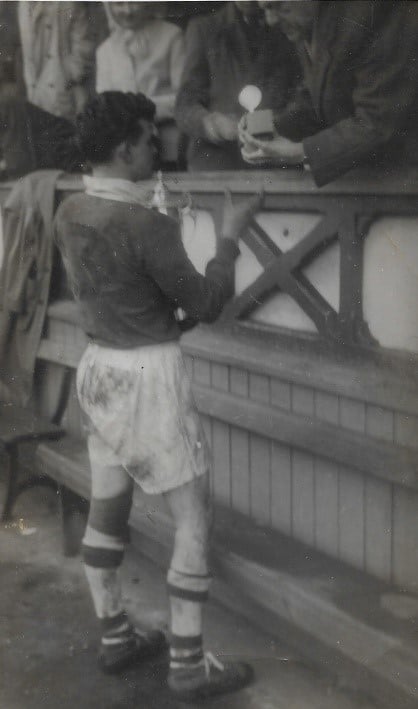
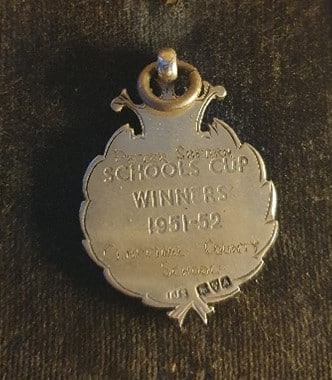
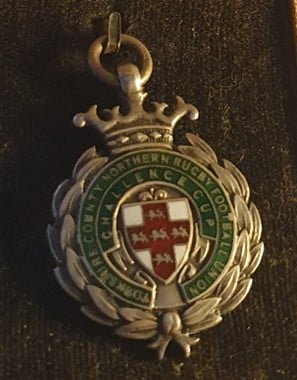
Peter went on to play at Halifax and had trials at Batley and Keighley.
Peter then had a successful amateur career playing for Ovenden. Not always easy when he was on National Service. But as the letters show, Ovenden were keen for him to play!

Also in 1952, Denis Hardy from Halifax captained Yorkshire Schoolboys against Cumberland and Peter Shearn also gained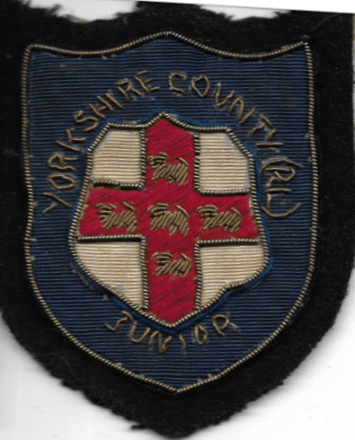 Yorkshire School honours.
In 1950’s, Ovenden School U13 won the Māori Trophy coached by Halifax half back, Ken Dean and St Joseph’s Catholic School won the Halifax Schools knock-out cup in the 1955 with the final being played at Thrum Hall.

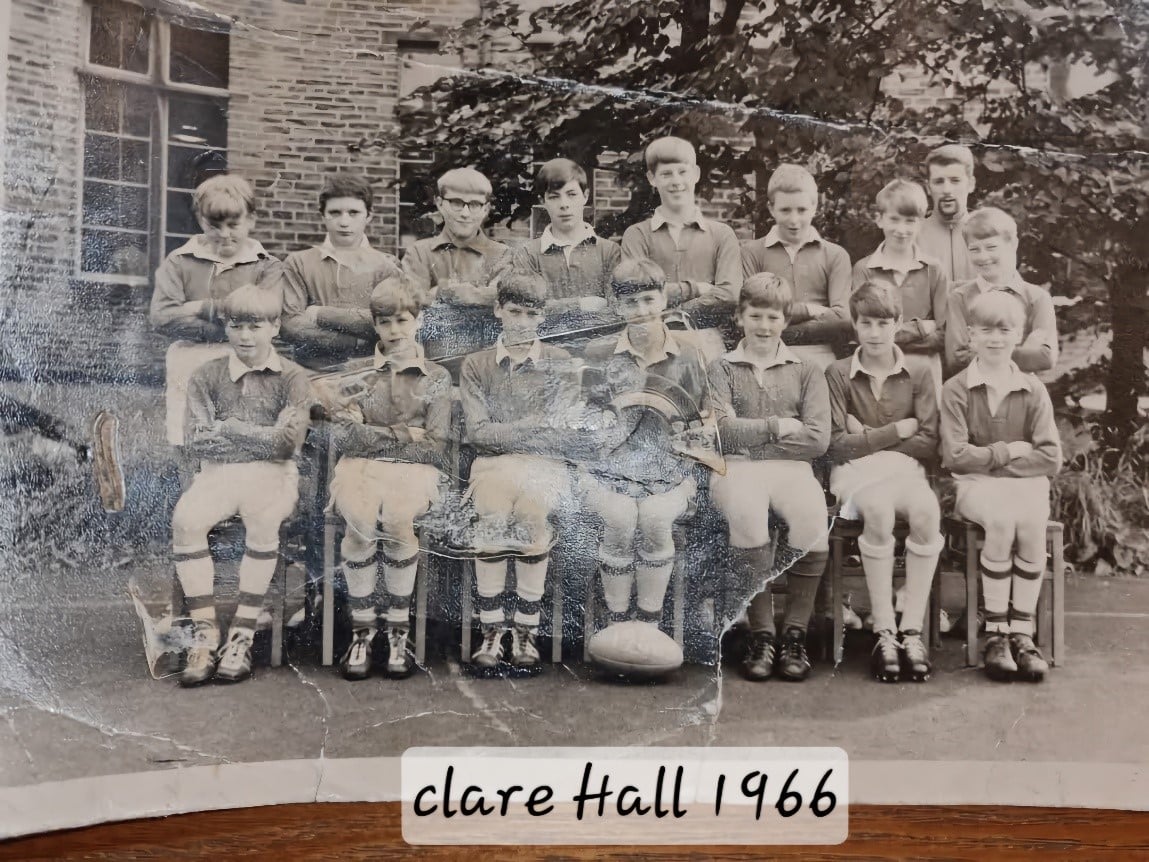
Clare Hall School was a real hot bed of Rugby League in the 1950’s and 1960’s although a series of different school would win the Courier Bowl in the 1960. Clare Hall would win the Courier Bowl in 1962 and again in 1966 and 1967 setting a record at the time for the most wins.
Robinson, Dixon, Drake, Whitehead, Hobson, Jordan, Hammond, Thompson, Chandler, Connell, Oakley, Kellett (captain),Hoult, Shearn , Oddy.
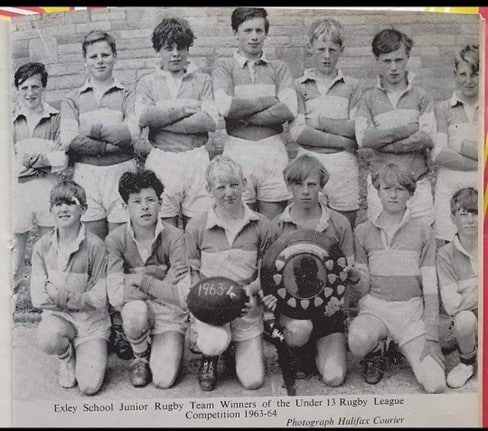
Exley Secondary School put its name on the Courier Bowl for the first time in 1961 and the school was slowly establishing itself as one of the schools to beat. In 1964, their U13’s won the Māori Shield.
Other notable wins were the consecutive wins by Sunnyside School in 1964 and 1965 as Laurie Hincliffe captained the side in the second of these victories.
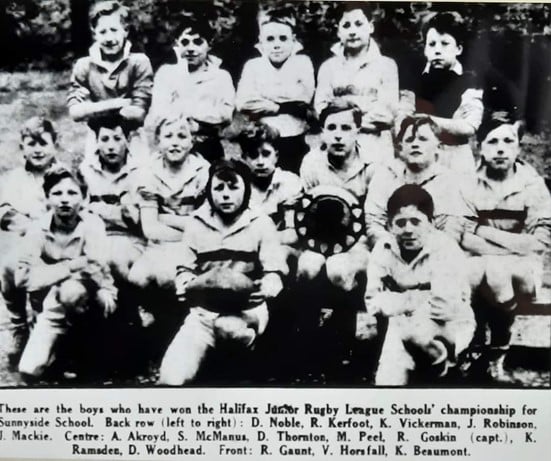
Sunnyside School also won the Māori Shield in the 1960’s.
By the end of the 1960s, schoolboy Rugby League in Halifax was struggling somewhat as the changes in the education system formed comprehensive schools out of the existing secondary schools where Rugby League was traditionally strong.
The Halifax Schools Rugby League was part of the Halifax Schools Athletic Association. This association covered all sports, girls and boys. This included cricket, Rugby League, soccer, netball, rounder as well as field and track athletics. The association published a handbook for many years.
In 1968 the Rugby League entry read:

As schools Rugby League was waning mirroring the fate of the professional club, some schools and their P.E. teachers such as Phil Taylor at Ovenden School and Kevin Allen and Richard Malloy at Halifax Catholic High School. Eventually, both schools looked for fixtures further afield and Ovenden School went to play in in the Bradford Schools League whilst Halifax Catholic High School went to play in the Huddersfield Schools Competition winning their knockout cup.
Prior to 1974, all junior Rugby League, below U17’s, was played almost exclusively in schools, which meant that many young pupils at schools which did not have Rugby League in their weekly curriculum (as most did not) did not get the chance to learn the skills of Rugby League.
The Courier Bowl was still competed for in the 1970’s and it was Halifax Catholic High School which became the leading school at the beginning of the decade and Ovenden School who gradually became the best Rugby League school. By the end of the decade, Ovenden School had won the Courier Bowl four times and their win in 1980 meant they matched Clare Hall School’s record of 4 successive wins and seven overall wins.
1980 was also the start of Andy Smith’s teaching career here in Halifax. With his background in Rugby League, he brought the game to the soccer orientated Halifax Catholic High School. Andy recalls,
“in the 1980’s P.E. teachers worked Saturday morning.”
But by the end of the 1980’s and the teachers’ action of the early 1990’s meant that only a handful would continue”.
The action Andy refers to the reaction to the the Teachers' Pay and Conditions Act 1987 and the Teachers’ Pay and Conditions Act 1991: one of the more serious outcomes of these new laws was the curtailment of outdoor recreation. Teachers’ hours and responsibilities became more proscribed and their pay linked to this. Many teachers, especially those involved in sports and other out of school time activities ceased their participation.
However, some schools Rugby League did continue although it appears that the Courier Bowl was only competed for in 1980 when Ovenden School lifted the trophy.
By this time amateur clubs had begun to form their own junior set ups as they had qualified Rugby League coaches who delivered training sessions and games on a regular basis whereas schools were perhaps playing 4 games per year. The schools Rugby League became a season of two halves: September/October for the League and February/March for the Cup.

There was a Halifax Schools Athletic Association and schools Rugby League was part of this. Indeed, Andy Smith was Chairman from the mid-1990’s through to 2005. From the mid-1980’s the Halifax & District Schools Rugby League Association was active with Steve Box at the helm from 1986 to 1990 when he had to step down due to health reasons. Steve was proactive in setting up links with Halifax RLFC and organising many District teams and local schools Rugby League events at all levels.
By the end of the 1980’s Halifax and District Schools’ teams were winning their respective leagues in the Yorkshire and Humberside School Leagues. In the 1989-90 season, the Halifax & District Under 16;s won their league winning everyone of their games!
Kevin McCallion joined the staff at Exley Secondary School as Head of Boys P.E. from Airdale High School in Castleford and had been to Wembley with the Castleford Schools U 11’s. He remembers Andy Smith,
“Andy was the driving force behand schools Rugby League in Halifax, chair of the Halifax Schools Rugby League and the Halifax Schools Athletic Association”.
Both were to be part of the Halifax Schools U 11 team trip to Wembley in 1991. (see below).
There were plenty of schools playing at least some Rugby League and participating in the Schools league and cup. These included Sowerby Bridge High, Halifax Catholic High, Hipperholme & Lightcliffe High, J. H. Whitley High, Brighouse High, W,H, Smith High (Rastrick) and Ryburn High as well as Exley.
Both Andy and Kevin recalled the special nature of the schools’ finals held at Thrum Hall.
“They were really special occasions for the players”.
But as with all Halifax finals, the closure of Thrum Hall took away that special feeling of playing where their Halifax heroes played. The finals were then just on school pitches losing that magic they once had.
By the mid-1990’s the Saturday morning schools’ Rugby League games had disappeared replaced by evening or afternoon games. There were however some big rivalries. Sowerby Bridge and Exley was perhaps the fiercest of these rivalries, although some will argue that the rivalry between Halifax Catholic High and Ovenden was more intense with some closely fought games and a few snowball fights off it.
There were some talented players coming through the schools’ teams. Steve Greenwood and Graham Holroyd from Sowerby Bridge High, the Grix’s from Catholic High, and James McGee, Richard Pearson and Mathew Topliss from Exley to name but a few.
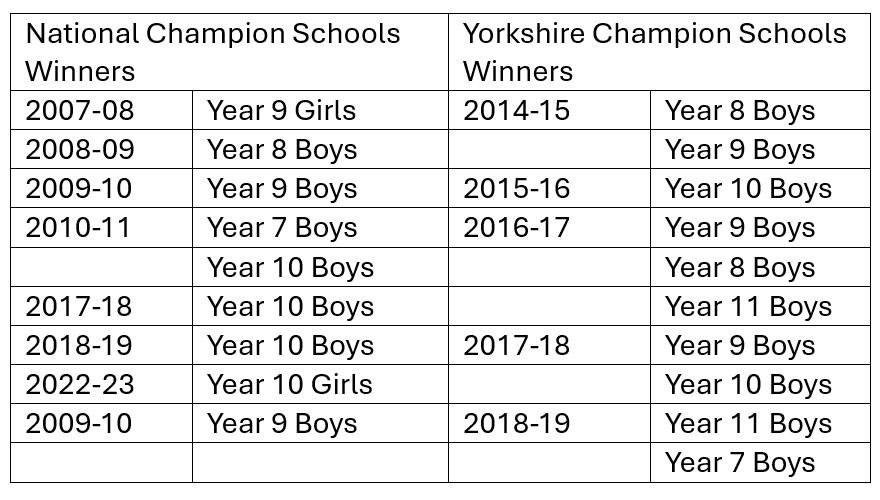
However, school teams do still play, very successfully in the case of Brooksbank School in Elland, who have used their sports college status and the coaching of P.E. teachers Damian Ball and Tim Webster to produce some of the best teams in the whole country in the years in recent years. Various year groups, both boys and girls, have won Champion Schools national titles, featuring such as Kruise Leeming, Chester Butler and Nick Rawsthorne, Morgan Smithies, Amir Bourouh, Matty Nicolson and Riley Dean.
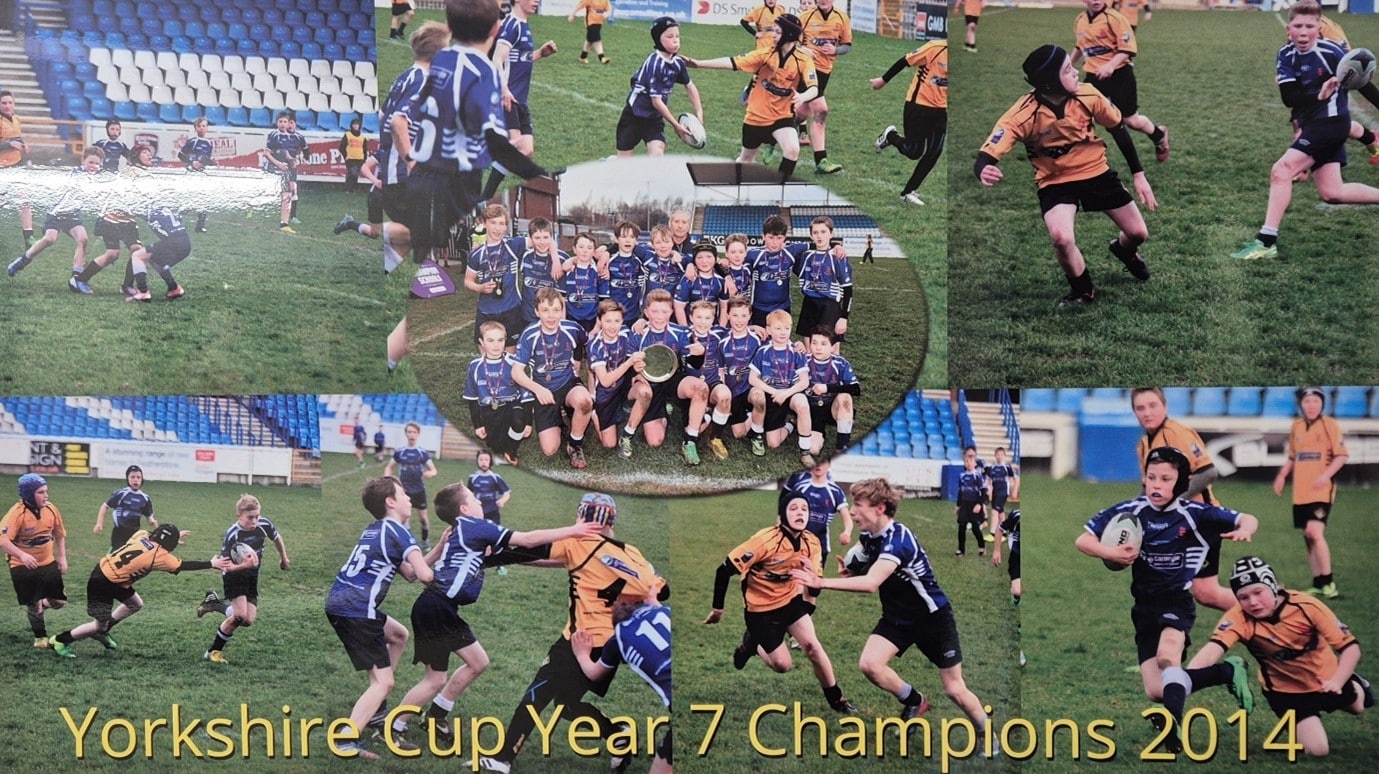
Brooksbank Year 7s qualified for the Wembley Cup Final curtain-raiser in 2011, as had the Halifax Schoolboy representative team twenty years earlier. Brooksbank teams also made the finals of the RFL Champion School Competition over the years. Damian Ball who has been teaching and championing Rugby League at Brooksbank since 2006, enthused
“The weekends down in London were great and Wembley was the best”.
For several years, the Champion Schools Finals were all played down in London but eventually they were played in Warrington and then at other venues in the north of England.
Brooksbank School has been the top Rugby League school in Halifax for many years with the only other Halifax team to win a National Champion School winner was the North Halifax High Girls Year 9 team in 2008.
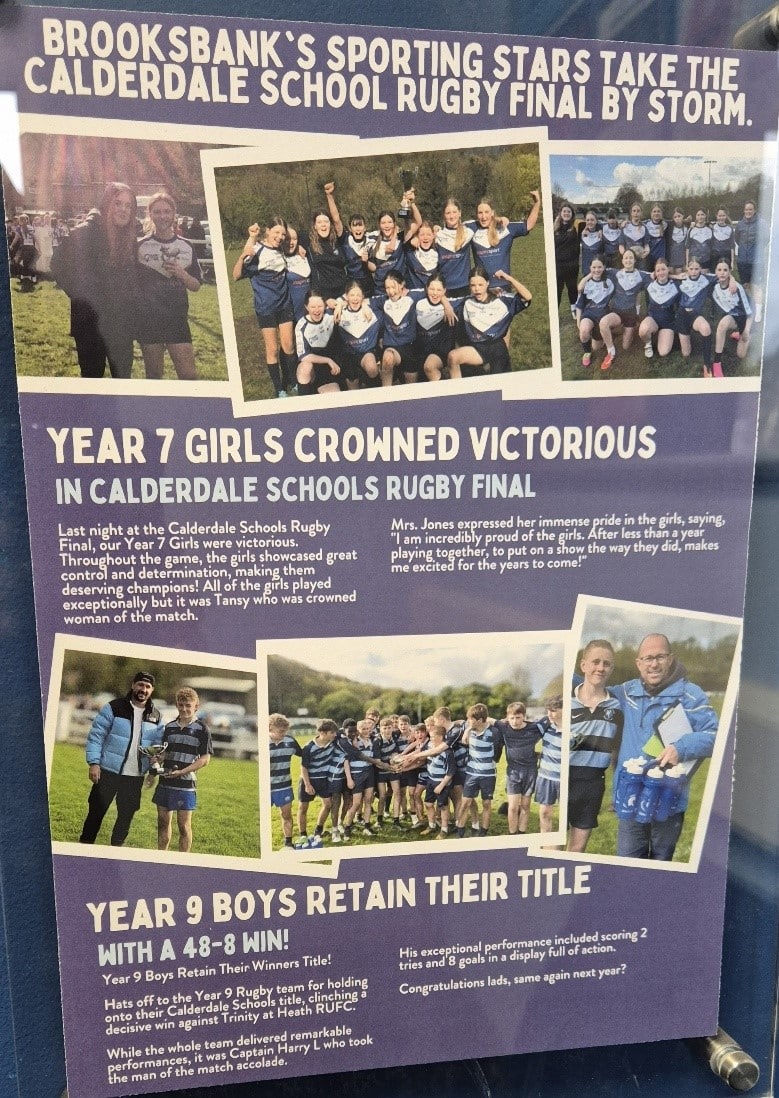
Brooksbank’s roll of honour is impressive.
The Halifax 1895 Cup winners in 2023 included three former Brooksbank students in Ben Kavanagh, Jacob Fairbank and Will Calcott, while the women’s final earlier that afternoon included Amy Hardcastle (Leeds) and Phoebe Hook (St Helens). Others in the Halifax squad with local connections were Zack McComb, James Saltonstall, Adam O’Brien, Tom Inman and Dan Fleming.
Current professional players who played at Brooksbank include Kreuze Leeming, Morgan Smithies, Matty Nicholson, Morgan and Jacob Gannon and Chester Butler.
Schools like Brooksbank are keeping schools Rugby League alive in Halifax. In 2025 the Calderdale Schools Rugby League Finals were held over two evenings in April including boys and girls teams from Ryburn, Brighouse, Trinity, and Calder High.
The major community Rugby League clubs in Halifax and District, Siddal, King Cross Park, Illingworth, Brighouse Rangers, Greetland and Elland together with Boothtown Terriers, all now have their own well established junior structures and all now have their own facilities. These clubs with teams in the many different age-group sections of the Yorkshire Junior League and their legions of dedicated coaches now fill the gap which was left by the reduction of schools Rugby League.